Wednesday, 23 September 2026

๐Ÿšจ FROM A MALICIOUS SITE TO FULL SYSTEM CONTROL — HOW DOES IT HAPPEN?

⚠️ Educational Security Demonstration  •  For Awareness Only  •  No Real Exploits

๐Ÿšจ From a Malicious Site to Full System Control — How Does It Happen?

// threat-intel brief :: social-engineering → browser boundary → system impact

๐Ÿ”’  https://too-good-to-be-true.example/reward ⚠ UNVERIFIED
๐Ÿ’ก What happens when a professional-looking website combines fake rewards, countdown timers, testimonials, and alarming security warnings?

This educational cybersecurity demonstration explores how a seemingly harmless webpage can be engineered to create urgency, trust, and fear — the exact psychological levers frequently abused in real-world malicious campaigns.

๐Ÿ”ด The Attack Chain STEP-BY-STEP

๐ŸŽฃ The Hook — Social Engineering Triggers

Fake rewards, countdown timers, testimonials, and alarming warnings work together to rush your judgment before your skepticism wakes up. Urgency, trust, and fear — the classic trifecta.

๐ŸŽ fake rewards ⏳ countdown pressure ๐Ÿ’ฌ fake testimonials ⚠️ scary warnings

๐Ÿ“ Browser Security Boundary

The demo presents a simulated local-file-access scenario to illustrate why browser security boundaries and isolation mechanisms are critical — and what's at stake when they're challenged.

๐Ÿ’ฅ Potential System Impact

In a real-world vulnerability scenario, a compromised browser could become a pathway toward serious system compromise. The exact impact depends on the vulnerability, browser protections, operating system, permissions, and whether additional security controls are bypassed.

๐Ÿง  The Biggest Lesson

๐Ÿšซ Don't judge a website by how professional it looks.

A polished interface does NOT automatically mean a website is trustworthy.

๐Ÿ›ก️ Your Defensive Playbook CHECKLIST

✅Keep browsers & operating systems fully updated
✅Use trusted and verified websites only
✅Review browser permissions carefully
✅Avoid suspicious downloads & unexpected prompts
✅Distrust "too good to be true" offers
✅Never let urgency or fear override security judgment
✅Treat unexpected security warnings with skepticism
๐Ÿ” SECURITY AWARENESS MATTERS

This project was created purely for educational and security-awareness purposes.

The objective is to demonstrate how malicious-looking webpages use social engineering, deception, urgency, and simulated technical compromise to influence users — and why understanding these techniques is a core cybersecurity skill.

spot the tricks → stop the attack
click without thinking
trust without verifying
proceed without securing
think before you click
verify before you trust
secure before you proceed

๐Ÿ“ก Follow the Complete Engineering Journey

Subscribe for more security, full-stack development, automated testing, CI/CD, DevOps, quality engineering, and software engineering projects.

Friday, 11 September 2026

๐Ÿ›ก️ HOW TO DEVELOP AN ORACLE ASSESSMENT TOOL: TO FIND RISKS BEFORE ATTACKER PENETRATE?

⚠ Authorized knowledge // Defensive security // Build & assess ⚠
🛡️

How to Develop an ORACLE ASSESSMENT TOOL : To Find Risks Before Attackers Penetrate?

database security • automated scanning • risk discovery
Live Demo
▶ watch the full walkthrough
📁 What this demo covers: An Oracle database security assessment using an automated scanning tool that examines database services, network exposure, patch coverage, authentication controls, privileges, and potential attack paths — all within a structured security assessment workflow.

🧮 Key Security Lessons

🔒A latest-version database can still have security findings.
🔒Database security requires more than version management.
🔒Credential, privilege, OJVM, TNS, XDB, and ORDS services should be continuously monitored.
🔒Patch coverage should be measured by service, severity, and exposure.
🔒Exposed listeners should be continuously monitored.
🔒Manual review is also important for validating automated scan results.
🔒Remediation should be prioritized by business risk and exploitability.

🎯 Final Takeaway

This demonstration shows how an automated Oracle database security scanner can combine network discovery, service detection, database assessment, patch analysis, credential testing, privilege review, and exploitation-oriented checks into a single security report.

⚠️ Security Takeaway

🟢Keeping a database up to date is important — but continuous assessment is equally essential.
🔵Scan regularly. Patch quickly. Reduce exposure. Protect the data.
SCAN • PATCH • HARDEN • REPEAT

📺 Complete Video Playlist

Oracle Security Series
📚 all episodes in one place — bookmark for later

Wednesday, 9 September 2026

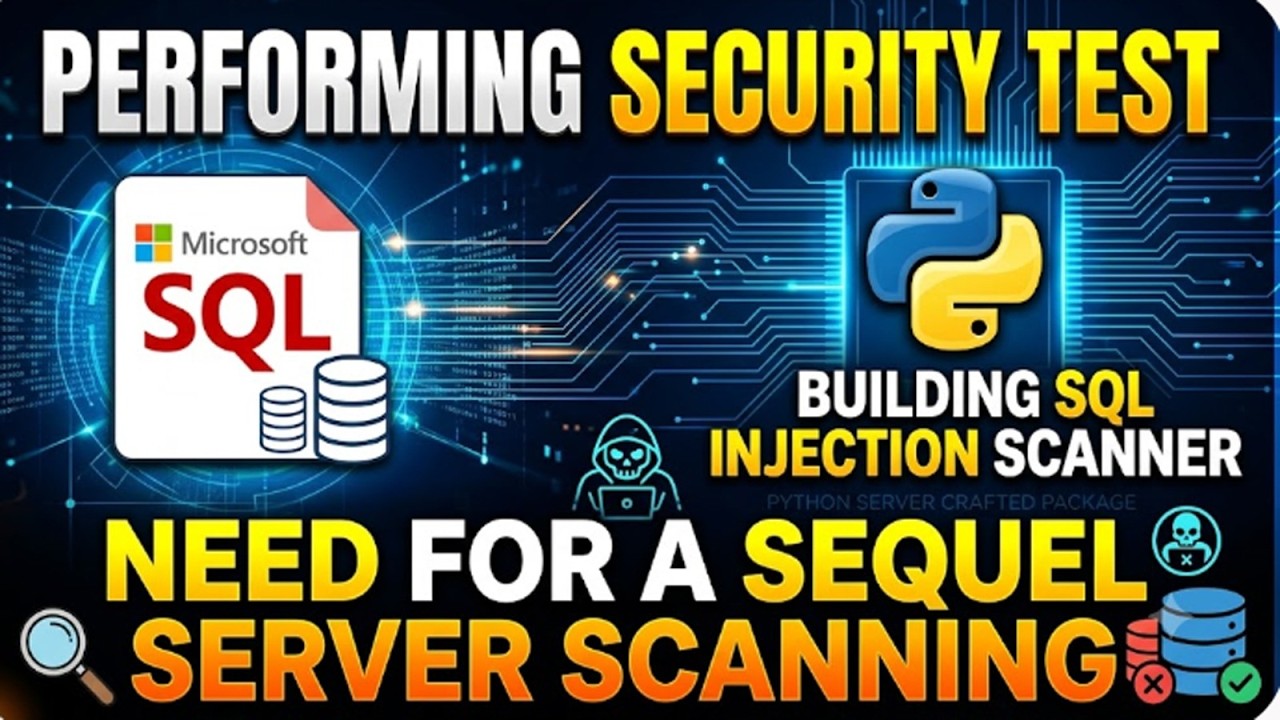
PERFORMING OF SECURITY TEST ON MICROSOFT SQL SERVER BY BUILDING SQL INJECTION SCANNER IN PYTHON

๐Ÿ” Microsoft SQL Server Security Assessment

From SQL Discovery & Reconnaissance to Critical Security Findings

๐Ÿ›ก️ What happens when Microsoft SQL Server goes through a security-focused assessment?

This demo walks through a complete security assessment of a SQL Server Express instance — SQLEXPRESS, covering discovery, reconnaissance, security probes, database auditing, risk analysis, and final security findings.

⚠️ The key lesson is simple: being patched does not automatically mean being secure.

๐Ÿ”Ž 01 — SQL Discovery | Know Your Target

๐Ÿงญ 02 — Reconnaissance | Understand the Environment

๐Ÿงช 03 — Security Probe | Test the Controls

๐Ÿšจ OVERALL RISK RATING
CRITICAL
Target: SQLEXPRESS
๐Ÿ”ด2 Critical
๐ŸŸ 3 High
๐ŸŸก3 Medium
๐Ÿ”ต4 Low
⚪2 Info
๐ŸŸข24 Passed

๐ŸŽฏ Final Security Takeaway

A SQL Server can be fully patched and still present significant security risk.

⚠️ Misconfiguration + Excessive Privileges + Weak Identity Controls + Exposed Services = Increased Attack Surface

Security is not a single checkbox. It is the combined result of patching, configuration, identity, privileges, monitoring, and continuous assessment.

๐Ÿ” Discover  →  ๐Ÿงญ Recon  →  ๐Ÿงช Probe  →  ๐Ÿšจ Assess  →  ๐Ÿ›ก️ Harden

Secure the database. Secure the data. Secure the business.

๐Ÿ“บ Continue the Security Journey

๐Ÿ” Explore the complete collection of security, software engineering, automation, testing, CI/CD, DevOps, and development demonstrations.

๐Ÿ›ก️ Learn. Test. Secure. Repeat.

▶️ Watch the Complete Security Playlist

#CyberSecurity   #SQLServer   #DatabaseSecurity   #SecurityAssessment   #VulnerabilityManagement   #InfoSec   #PenTesting   #DataSecurity   #DevSecOps   #SecurityEngineering   #SQLSecurity

Sunday, 6 September 2026

๐Ÿšจ Beware if You Use Chrome: Critical Security Risks Across Versions

๐Ÿ” Chrome Security Intelligence

๐Ÿšจ Beware if You Use Chrome:
Critical Security Risks Across Versions

What if your browser is fully up to date — but still vulnerable? Browser version checks alone may not provide the complete security picture.

⚠️ Latest Version ≠ Automatically Safe

๐Ÿ›ก️ Why this matters: Modern browsers are a major enterprise attack surface. A malicious or compromised webpage can potentially trigger vulnerabilities leading to code execution, information disclosure, spoofing, crashes, or sandbox escape.

Browser security therefore needs to go beyond simply asking: “Is Chrome up to date?”

๐Ÿ”ด The Important Security Reality

“Up to date” ≠ “Immune to active exploitation.”

When active exploitation exists before an official vendor fix is available, organizations can face a temporary patch-gap risk.

๐ŸŽฏ Why Browser Vulnerabilities Matter

๐Ÿ”ด

Critical Attack Paths

Memory corruption, remote code execution, and sandbox escape vulnerabilities can potentially turn a malicious webpage into a serious endpoint security threat.

⚡

Patch-Gap Exposure

A browser may report that it is running the latest available release while security exposure remains until the underlying vulnerability is officially fixed.

๐ŸŒ Malicious Webpage
→
๐Ÿ’ฅ Memory Corruption
→
๐Ÿ”“ Sandbox Escape
→
๐Ÿ’ป Code Execution

๐Ÿ›ก️ What Security Teams Should Do

Browser security should go beyond checking the installed version. Security, DevOps, and Operations teams should continuously monitor vulnerability intelligence and endpoint exposure.


๐Ÿ”Ž Monitor actively exploited browser vulnerabilities.

⚡ Patch and verify browser updates rapidly across endpoints.

๐Ÿ–ฅ️ Scan enterprise devices for vulnerable browser versions.

๐Ÿšจ Prioritize sandbox escape and remote-code-execution risks.

๐Ÿ”’ Apply containment controls when no official fix is available.

๐ŸŒ Maintain an approved alternative browser for critical business activities.

๐Ÿšจ What If There Is No Official Patch?

  • Evaluate the business impact and affected endpoints.
  • Increase monitoring for suspicious browser activity.
  • Apply appropriate enterprise containment controls.
  • Restrict browser usage where the risk is unacceptable.
  • Move users to an approved, unaffected browser for critical business activities when appropriate.
  • Continue monitoring until an official security fix becomes available.
๐ŸŽฏ

The Security Takeaway

Browsers are more than applications for viewing websites. They process JavaScript, documents, credentials, authentication tokens, and sensitive corporate data — making browser vulnerabilities a serious enterprise security concern.

Patch fast. Monitor continuously. Verify everywhere.

๐Ÿ” Security is a continuous process — not a version number.
๐Ÿ’ก Remember

The latest version is not necessarily the safest version when active exploitation is ahead of the patch.

Wednesday, 2 September 2026

๐Ÿง  Performance Testing Meets AI Architecture: Are We Ready for Autonomous Quality Engineering?

Intelligent Quality Engineering • 2026

๐Ÿš€ Performance Testing Meets AI Architecture: Are We Ready for Autonomous Quality Engineering?

Performance engineering is entering a new era — where AI, observability, autonomous testing, and continuous optimization converge.

Performance testing is entering a new era.

For years, the objective was relatively straightforward: generate load, measure response time, identify bottlenecks, tune the system, and repeat.

But modern applications are no longer simple monolithic systems. They are distributed, cloud-native, API-driven, data-intensive, and increasingly powered by AI agents.

๐Ÿง  ๐Ÿค– ⚡

What happens when AI becomes part of the performance-testing architecture itself?

Imagine a testing environment where intelligence is embedded into every stage of the performance engineering lifecycle.

๐ŸŒ The AI-Powered Performance Testing Vision

Imagine a futuristic testing environment where AI continuously understands the architecture, generates realistic workloads, monitors distributed services, analyzes telemetry, identifies anomalies, and recommends optimization strategies.

๐Ÿง 

AI-Driven Test Generation

AI-driven test generation can help create and prioritize scenarios based on application behavior, architecture, and risk.

๐Ÿค–

Autonomous Testing Agents

Autonomous testing agents can execute complex workflows, generate workloads, investigate failures, and dynamically adapt test strategies.

⚡

High-Throughput Performance Pipelines

Continuously challenge microservices, APIs, databases, event streams, and cloud infrastructure with realistic workloads.

๐Ÿ“Š

Intelligent Observability

Correlate metrics, logs, and traces to move beyond simply detecting that something failed toward understanding why it failed.

๐Ÿ”„

AI Feedback Loops

Connect test results back to architecture and engineering decisions, enabling continuous optimization rather than one-time performance validation.

The Shift Is Already Happening

And this is not just a futuristic concept.

In 2026, AI-assisted testing is increasingly moving into real engineering workflows, while organizations are also discovering that AI-generated functionality introduces new quality, reliability, observability, and governance challenges.

The performance engineering discipline is therefore evolving alongside the systems it is designed to validate.

๐Ÿค– Why Agentic AI Changes Performance Testing

There is another important shift happening.

With agentic AI, testing can no longer focus only on isolated requests or individual components. AI agents may execute multi-step trajectories involving planning, memory, tool usage, and interaction with distributed environments.

New testing dimensions include:

  • Temporal behavior across multi-step agent workflows
  • Runtime monitoring of continuously changing behavior
  • Multi-agent interactions and distributed decision-making
  • Bounded autonomy to ensure agents operate within safe and predictable limits

❓ The Questions Performance Engineers Must Start Asking

This means the future performance engineer may not simply ask:

“How much load can the system handle?”

Instead, the questions become:

๐Ÿ”ฎ

Can the AI predict the bottleneck?

๐Ÿ”„

Can the system adapt under changing workloads?

๐ŸŒ

Can we continuously validate performance in production-like environments?

๐Ÿ”

Can AI explain why performance degraded?

๐Ÿ›ก️

Can autonomous agents test safely without creating new risks?

๐Ÿ—️ The Architecture of Tomorrow

The architecture of tomorrow's testing ecosystem could look something like this:

AI Architecture
→
Automated Test Generation
→
Distributed Load
→
Real-Time Observability
→
Intelligent Analytics
→
AI Optimization

๐Ÿ‘ฉ‍๐Ÿ’ป The Goal Isn't to Replace Performance Engineers

The goal is to augment engineering intelligence — allowing teams to explore more scenarios, detect emerging risks earlier, understand complex distributed behavior, and continuously improve system resilience.

Human expertise remains critical for defining objectives, interpreting business risk, establishing guardrails, validating AI recommendations, and making architectural decisions.

๐Ÿš€

The Future of Performance Testing

The future of performance testing may therefore be less about testing harder and more about testing intelligently.

Performance Engineering + AI + Observability + Autonomous Testing
=
Intelligent Quality Engineering

The next generation of high-performance systems won't just be built to scale.

They'll be continuously learning how to perform better. ๐Ÿš€