Showing posts with label Quality Engineering. Show all posts

Tuesday, 29 September 2026

๐Ÿงช SS INDUSTRIAL OPS ANALYTICS — FROM FACTORY DATA TO OPERATIONAL INTELLIGENCE (DATA ANALYTICS ) -TESTS

๐Ÿญ SS Industrial Ops Analytics — Tests

From Factory Data to Operational Intelligence — Data Analytics

๐Ÿญ SS Industrial Ops Analytics — Playlist

Browse the complete demo series in one embedded playlist — analytics, testing, streaming and CI/CD.

๐Ÿงช Testing Demo: From API Contracts to End-to-End

A complete testing strategy validates the system at multiple levels:

๐Ÿ”ต API Contract Testing

REST endpoints are tested with positive and negative scenarios — JWT errors, invalid pagination, malformed JSON, security payloads, and role-based access.

๐ŸŸข Analytics Functional Testing

Mathematical correctness is validated through OEE, MTBF, bottleneck calculations, aggregation consistency, ETL flow, and KPI invariants.

๐ŸŸ  Playwright End-to-End Testing

Real browser workflows validate:

  • ๐Ÿ” Duplicate data does not increase counters
  • ๐Ÿ“ฆ Batch processing updates production/data counts
  • ⚡ Streaming events increase event counters

๐Ÿ”บ One Test Pyramid. Three Levels.

Analytics proves the numbers.
API testing proves the contract.
Playwright proves the complete user journey.

๐Ÿš€ Together, they provide confidence that the system is correct, reliable, and working end-to-end.

⭐

Follow the Complete Engineering Journey

Subscribe for more full-stack development, automated testing, CI/CD, DevOps, quality engineering, security, and software engineering projects.
```

๐Ÿญ SS Industrial Ops Analytics: From Factory Data to Operational Intelligence

๐Ÿญ SS Industrial Ops Analytics

From Factory Data to Operational Intelligence

Industrial Ops Analytics Playlist

Explore the complete demo series — data generation, analytics dashboards, testing workflows and streaming pipelines.

Industrial Ops Analytics Playlist

▶ Open Full Playlist

✨ Turning production data into actionable manufacturing insights.

๐ŸŸข What the Platform Delivers

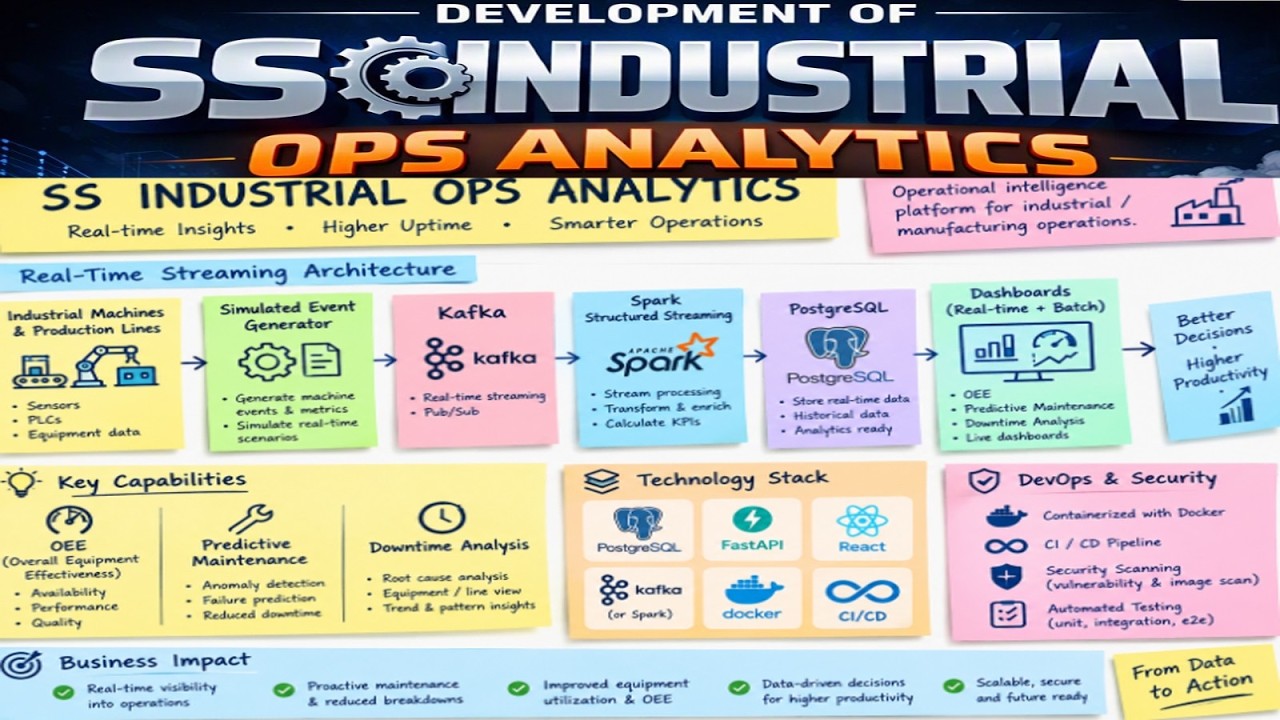
  • ๐Ÿ“Š OEE Intelligence — Availability × Performance × Quality
  • ⚙️ Production Analytics — Trends, line comparisons and production counts
  • ๐Ÿค– Predictive Maintenance — ML-based machine failure-risk prediction
  • ๐Ÿ› ️ Downtime Analytics — Pareto analysis and root-cause insights
  • ๐Ÿ”ฌ Quality Analytics — Rejection rates and shift/product comparisons
  • ๐Ÿšง Bottleneck Detection — Identify production constraints and capacity impact

๐Ÿ”ต From Data to Insights

The platform supports both batch processing and simulated real-time event streaming, with data flowing through:

Synthetic Data → ETL → PostgreSQL → Analytics → ML Predictions

For streaming:

Event Generator → Kafka → Spark Structured Streaming → PostgreSQL → Live Dashboards

๐ŸŸฃ Application Modules

๐Ÿ“ˆ Executive Summary ⚙️ Production
๐Ÿ“Š OEE ๐Ÿ’ป Machine Health
๐Ÿค– Predictive Maintenance ๐Ÿ”ฌ Quality
⏱️ Downtime ๐Ÿšง Bottlenecks
✅ Data Quality ❤️ System Health

๐ŸŸ  Quality Engineering

The demo also showcases analytics unit testing and coverage reporting, followed by upcoming demonstrations of:

  • ✅ Data analytics testing
  • ✅ Integration testing
  • ✅ Contract testing
  • ✅ Playwright End-to-End testing
  • ✅ Batch & live-streaming validation
  • ✅ CI/CD automation and security scanning

๐Ÿš€ Technology Stack

PostgreSQL Python FastAPI React/TypeScript Kafka Spark scikit-learn Docker CI/CD

๐ŸŽฏ The vision is simple: connect industrial data, analytics and AI to help teams understand performance, downtime, quality, machine health and production bottlenecks in one operational intelligence platform.

This is the beginning of a demo series covering the complete journey — from data generation and analytics to automated testing, streaming and CI/CD.

⭐

Follow the Complete Engineering Journey

Subscribe for more full-stack development, automated testing, CI/CD, DevOps, quality engineering, security, and software engineering projects.

```

Wednesday, 2 September 2026

๐Ÿง  Performance Testing Meets AI Architecture: Are We Ready for Autonomous Quality Engineering?

Intelligent Quality Engineering • 2026

๐Ÿš€ Performance Testing Meets AI Architecture: Are We Ready for Autonomous Quality Engineering?

Performance engineering is entering a new era — where AI, observability, autonomous testing, and continuous optimization converge.

Performance testing is entering a new era.

For years, the objective was relatively straightforward: generate load, measure response time, identify bottlenecks, tune the system, and repeat.

But modern applications are no longer simple monolithic systems. They are distributed, cloud-native, API-driven, data-intensive, and increasingly powered by AI agents.

๐Ÿง  ๐Ÿค– ⚡

What happens when AI becomes part of the performance-testing architecture itself?

Imagine a testing environment where intelligence is embedded into every stage of the performance engineering lifecycle.

๐ŸŒ The AI-Powered Performance Testing Vision

Imagine a futuristic testing environment where AI continuously understands the architecture, generates realistic workloads, monitors distributed services, analyzes telemetry, identifies anomalies, and recommends optimization strategies.

๐Ÿง 

AI-Driven Test Generation

AI-driven test generation can help create and prioritize scenarios based on application behavior, architecture, and risk.

๐Ÿค–

Autonomous Testing Agents

Autonomous testing agents can execute complex workflows, generate workloads, investigate failures, and dynamically adapt test strategies.

⚡

High-Throughput Performance Pipelines

Continuously challenge microservices, APIs, databases, event streams, and cloud infrastructure with realistic workloads.

๐Ÿ“Š

Intelligent Observability

Correlate metrics, logs, and traces to move beyond simply detecting that something failed toward understanding why it failed.

๐Ÿ”„

AI Feedback Loops

Connect test results back to architecture and engineering decisions, enabling continuous optimization rather than one-time performance validation.

The Shift Is Already Happening

And this is not just a futuristic concept.

In 2026, AI-assisted testing is increasingly moving into real engineering workflows, while organizations are also discovering that AI-generated functionality introduces new quality, reliability, observability, and governance challenges.

The performance engineering discipline is therefore evolving alongside the systems it is designed to validate.

๐Ÿค– Why Agentic AI Changes Performance Testing

There is another important shift happening.

With agentic AI, testing can no longer focus only on isolated requests or individual components. AI agents may execute multi-step trajectories involving planning, memory, tool usage, and interaction with distributed environments.

New testing dimensions include:

  • Temporal behavior across multi-step agent workflows
  • Runtime monitoring of continuously changing behavior
  • Multi-agent interactions and distributed decision-making
  • Bounded autonomy to ensure agents operate within safe and predictable limits

❓ The Questions Performance Engineers Must Start Asking

This means the future performance engineer may not simply ask:

“How much load can the system handle?”

Instead, the questions become:

๐Ÿ”ฎ

Can the AI predict the bottleneck?

๐Ÿ”„

Can the system adapt under changing workloads?

๐ŸŒ

Can we continuously validate performance in production-like environments?

๐Ÿ”

Can AI explain why performance degraded?

๐Ÿ›ก️

Can autonomous agents test safely without creating new risks?

๐Ÿ—️ The Architecture of Tomorrow

The architecture of tomorrow's testing ecosystem could look something like this:

AI Architecture
→
Automated Test Generation
→
Distributed Load
→
Real-Time Observability
→
Intelligent Analytics
→
AI Optimization

๐Ÿ‘ฉ‍๐Ÿ’ป The Goal Isn't to Replace Performance Engineers

The goal is to augment engineering intelligence — allowing teams to explore more scenarios, detect emerging risks earlier, understand complex distributed behavior, and continuously improve system resilience.

Human expertise remains critical for defining objectives, interpreting business risk, establishing guardrails, validating AI recommendations, and making architectural decisions.

๐Ÿš€

The Future of Performance Testing

The future of performance testing may therefore be less about testing harder and more about testing intelligently.

Performance Engineering + AI + Observability + Autonomous Testing
=
Intelligent Quality Engineering

The next generation of high-performance systems won't just be built to scale.

They'll be continuously learning how to perform better. ๐Ÿš€