Showing posts with label Docker. Show all posts

Tuesday, 29 September 2026

🏭 SS Industrial Ops Analytics: From Factory Data to Operational Intelligence

🏭 SS Industrial Ops Analytics

From Factory Data to Operational Intelligence

Industrial Ops Analytics Playlist

Explore the complete demo series — data generation, analytics dashboards, testing workflows and streaming pipelines.
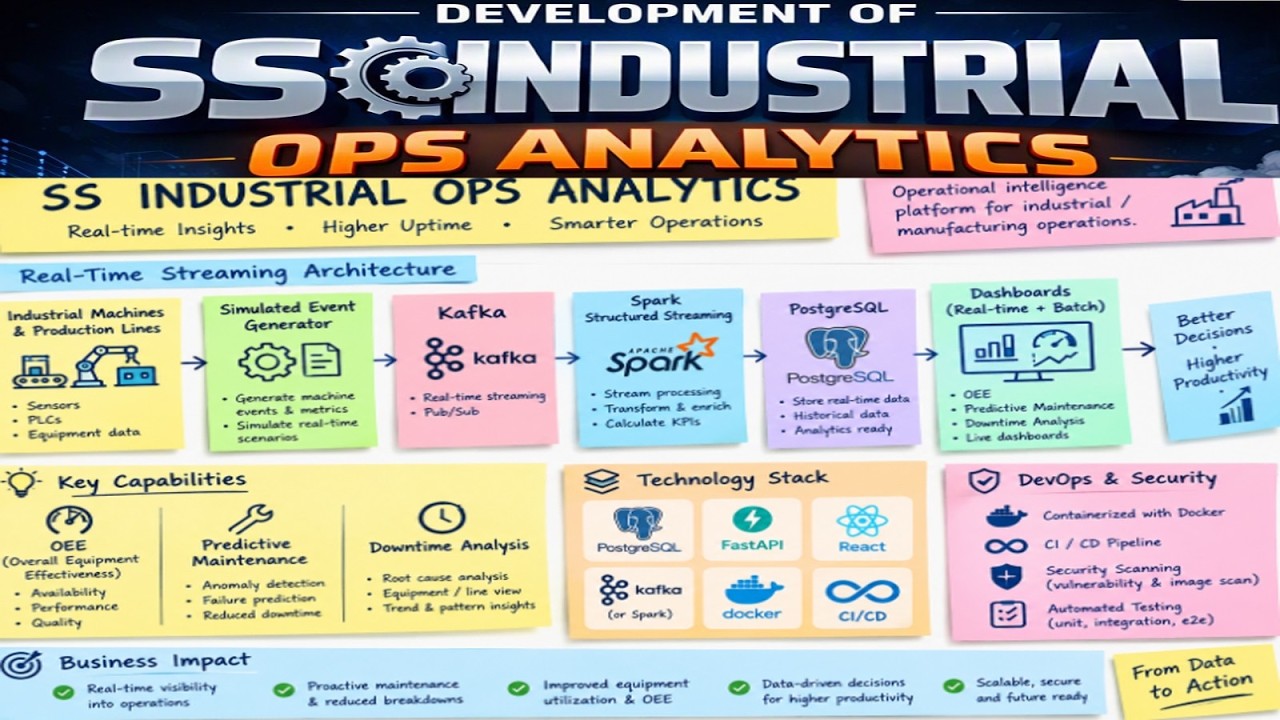
Industrial Ops Analytics Playlist

▶ Open Full Playlist

✨ Turning production data into actionable manufacturing insights.

🟢 What the Platform Delivers

  • 📊 OEE Intelligence — Availability × Performance × Quality
  • ⚙️ Production Analytics — Trends, line comparisons and production counts
  • 🤖 Predictive Maintenance — ML-based machine failure-risk prediction
  • 🛠️ Downtime Analytics — Pareto analysis and root-cause insights
  • 🔬 Quality Analytics — Rejection rates and shift/product comparisons
  • 🚧 Bottleneck Detection — Identify production constraints and capacity impact

🔵 From Data to Insights

The platform supports both batch processing and simulated real-time event streaming, with data flowing through:

Synthetic Data → ETL → PostgreSQL → Analytics → ML Predictions

For streaming:

Event Generator → Kafka → Spark Structured Streaming → PostgreSQL → Live Dashboards

🟣 Application Modules

📈 Executive Summary ⚙️ Production
📊 OEE 💻 Machine Health
🤖 Predictive Maintenance 🔬 Quality
⏱️ Downtime 🚧 Bottlenecks
✅ Data Quality ❤️ System Health

🟠 Quality Engineering

The demo also showcases analytics unit testing and coverage reporting, followed by upcoming demonstrations of:

  • ✅ Data analytics testing
  • ✅ Integration testing
  • ✅ Contract testing
  • ✅ Playwright End-to-End testing
  • ✅ Batch & live-streaming validation
  • ✅ CI/CD automation and security scanning

🚀 Technology Stack

PostgreSQL Python FastAPI React/TypeScript Kafka Spark scikit-learn Docker CI/CD

🎯 The vision is simple: connect industrial data, analytics and AI to help teams understand performance, downtime, quality, machine health and production bottlenecks in one operational intelligence platform.

This is the beginning of a demo series covering the complete journey — from data generation and analytics to automated testing, streaming and CI/CD.

⭐

Follow the Complete Engineering Journey

Subscribe for more full-stack development, automated testing, CI/CD, DevOps, quality engineering, security, and software engineering projects.

```

Sunday, 27 September 2026

🔴 HOW TO CONDUCT A SECURITY ASSESSMENT TEST ON LINUX DOCKER ENVIRONMENT?

Security Demonstration

HOW TO CONDUCT A SECURITY ASSESSMENT TEST ON LINUX DOCKER ENVIRONMENT?

Understanding Why Container Runtime Security Matters

Introduction

Containers provide an efficient way to isolate applications, but their isolation depends heavily on the security of the underlying container runtime and host operating system.

Container security is therefore not limited to application images. The runtime, Linux kernel, host configuration, privileges, permissions, and monitoring controls all contribute to the overall security boundary.

▶ SECURITY DEMONSTRATION CONTAINER → RUNTIME → HOST
🔐 Key Security Principle A container boundary should be treated as a security boundary that must be continuously protected, monitored, patched, and properly configured.

Container → Runtime → Host

The relationship between these three layers is central to understanding container security.

📦
Container

Application workload and isolated process environment.

⚙️
Runtime

Component responsible for creating and managing containers.

🖥️
Host

Operating system and infrastructure supporting container workloads.

Why Container Runtime Security Matters

Container security is not limited to application images. A secure environment also depends on several layers of infrastructure security.

  • ✓ Container runtime security
  • ✓ Linux kernel security
  • ✓ Host operating-system configuration
  • ✓ Container privileges and capabilities
  • ✓ Runtime permissions
  • ✓ Security controls and monitoring
01 Container
02 Runtime
03 Kernel
04 Host

Security Impact

If isolation controls are weakened, the impact of a container compromise can potentially extend beyond the individual application workload.

  • ! Host operating-system resources
  • ! Sensitive host files
  • ! Other workloads
  • ! Runtime credentials or configuration
  • ! Privileged host capabilities

The Security Lesson

⚠ Container Isolation Requires Continuous Protection

Container isolation is not an absolute security boundary. Vulnerabilities or misconfigurations involving container runtimes and privileged components can potentially turn a container compromise into a host compromise.

Security Recommendations

  • ✓ Keep Docker and the container runtime updated.
  • ✓ Apply security patches promptly.
  • ✓ Minimize container privileges.
  • ✓ Follow container-hardening best practices.
  • ✓ Monitor runtime and host activity for suspicious behaviour.
  • ✓ Regularly assess container environments for security weaknesses.
  • ✓ Review exposed capabilities and unnecessary permissions.
🛡️ Key Takeaway

A compromised container should not automatically become a compromised host. However, weaknesses in the container runtime, host configuration, or privileged components can make that boundary vulnerable.

Security Engineering Playlist

Explore the complete security engineering series, demonstrations, testing workflows, and related topics.

▶ Open Full Security Playlist

📡 Follow the Complete Engineering Journey

Subscribe for more security, full-stack development, automated testing, CI/CD, DevOps, quality engineering, and software engineering projects.

$ security.status --container-runtime
✓ Runtime security: MONITORED
✓ Container privileges: MINIMIZED
✓ Security patches: REQUIRED
⚠ Container isolation: SECURITY BOUNDARY
$ stay-curious --stay-skeptical --stay-secure